Runs and traces
The Logs timeline
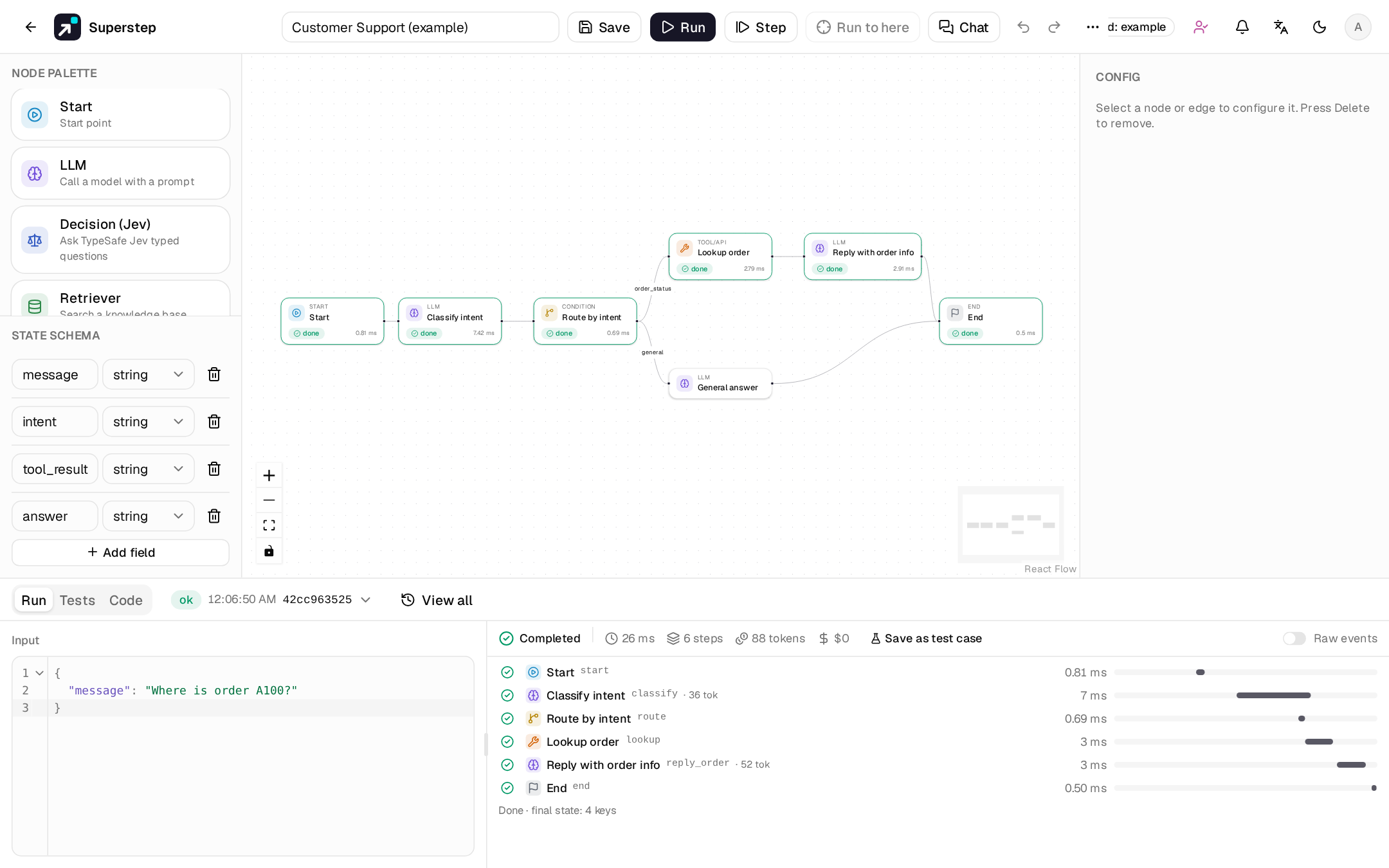
The logs in the Run tab have one row per node step: status, name, kind, duration, a
waterfall bar, and tokens when the model reports them. Loops show #2, #3
and so on. The summary line shows the run status, duration, steps, input and
output tokens, cost and error count.
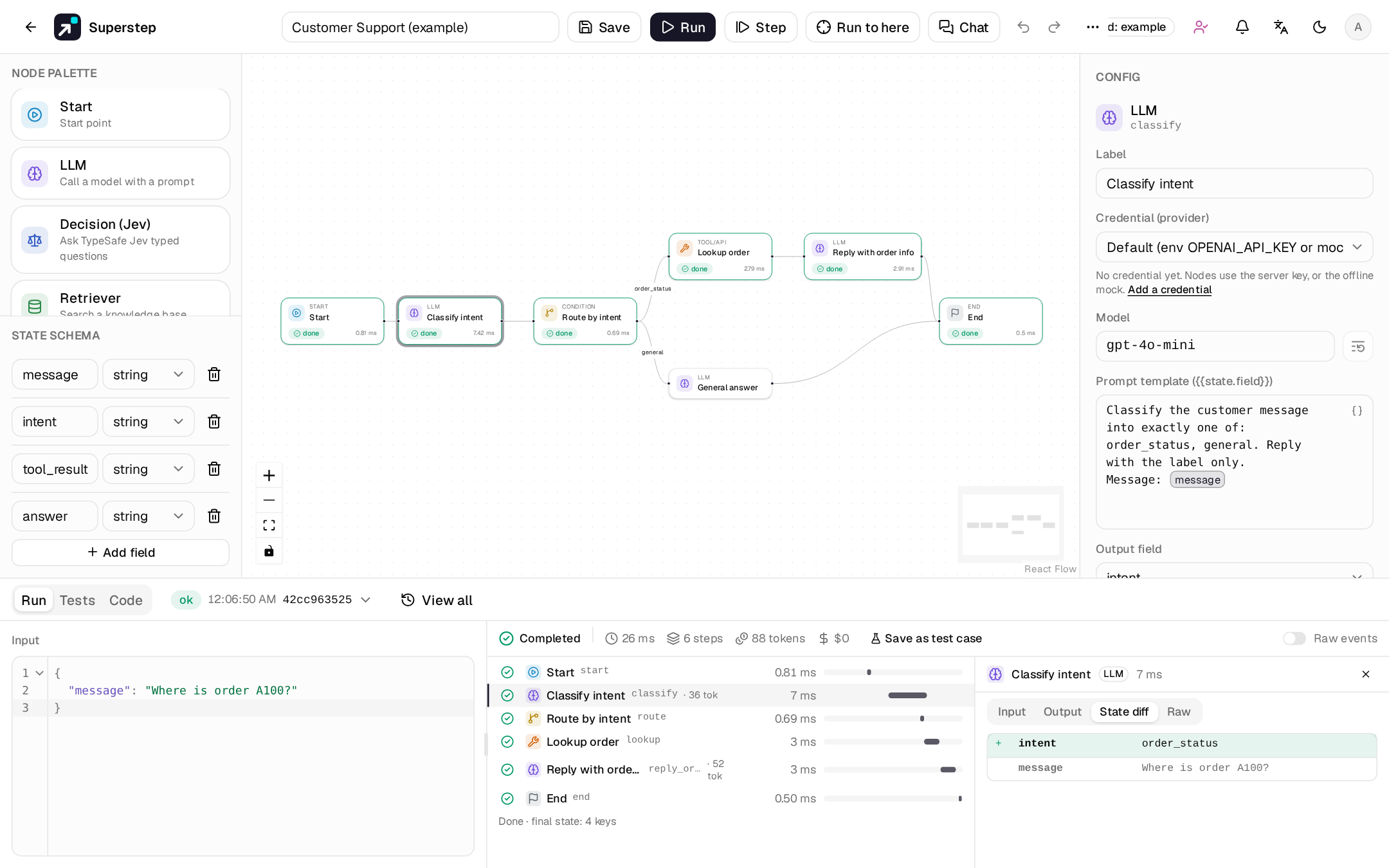
Click a row, or a node on the canvas, to open its detail:
| Tab | Shows |
|---|---|
| Input | The state the node received |
| Output | What it returned (streamed tokens for an LLM node while it runs) |
| State diff | Fields added, changed or removed by this step |
| Raw | The step's original events |
An Agent node shows its steps under it:
Agent › model rows with the round and the tools it called or its answer, and
Agent › tool rows with the tool, a shortened result, and approved or
rejected by a reviewer when a person answered.
Raw events switches the whole timeline to the original event stream. Pick an earlier run in the run menu next to the tabs (the last 10), or in View all, to replay it on the same timeline, labelled with its version.
Stepping
| Control | Effect |
|---|---|
| Step | Runs one superstep, then pauses the same run (status paused). |
| Continue | Runs the rest. |
| Run to here | Select a node first. Runs until that node finishes, then pauses. If the path never reaches it, the run finishes and says so. |
A pause is not a human approval. A superstep that is only Start does not use up the step.
Time travel: fork from a checkpoint
Open a finished run (or pick one in View all runs) and press Time travel above its timeline. The dialog lists the run's checkpoints: one per step, named after the nodes that ran next ("Before Approved?"), with the state they started from, and last the final state.
- Pick a checkpoint to inspect its state.
- Optionally edit the state (it must stay a JSON object). Reset puts the recorded state back.
- Press Fork from here. A new run starts at those nodes with that state; the nodes before it do not run again. Its timeline shows Forked from the original run and checkpoint. The original run is not changed.
A fork runs the workflow version the original run ran when that version is stored, else the saved workflow. Iteration counts (loop limits) carry over. Checkpoints whose state was too large to record, the final state, runs of imported LangGraph graphs and runs still waiting or running cannot be forked. Only the run's owner (or the workflow's owner and admins) can see its checkpoints.
GET  /api/runs/{run_id}/checkpoints
WS   /ws/run   {"fork": {"run_id": "...", "checkpoint": 1, "state": {...}}}   (state is optional)
Cancel
Cancel (Ctrl+.) sends {"type": "cancel"}. Closing the tab also
cancels. Cancel is cooperative: it stops between steps, so an LLM or HTTP call
already in flight may finish. A Code node's container is killed.
Statuses
| Status | Meaning |
|---|---|
ok |
Reached End. |
error |
A node failed after its retries, or validation failed. |
cancelled |
Stopped by a person or a closed tab. |
timeout |
Ran past STUDIO_RUN_TIMEOUT. |
paused |
Stopped by Step or Run to here. |
waiting |
At a Human node. |
expired |
Waited longer than STUDIO_WAIT_TTL. |
Errors are one line, with sk-…, Bearer … and api_key=… redacted.
Limits
| Variable | Default | Meaning |
|---|---|---|
STUDIO_RECURSION_LIMIT |
25 | Max steps per run. A loop that never passes a Condition stops with an error. For each steps do not count. |
STUDIO_RUN_TIMEOUT |
120 s | Max duration of a run, then timeout. Waiting at a Human node does not count, and neither does the setup before the first node (such as saving the first progress checkpoint). |
STUDIO_EVENT_MAX_BYTES |
262144 | Max size of one event. Oversized fields become {"_truncated": true, …}. |
STUDIO_RUN_MAX_BYTES |
2097152 | Max stored events per run. The middle is replaced by {"type": "truncated", "dropped": n}. |
STUDIO_INPUT_MAX_BYTES |
262144 | Max run input. |
STUDIO_WORKFLOW_MAX_BYTES |
1048576 | Max workflow JSON. Larger saves return HTTP 413. |
The timeline also clips input and delta at 16 000 JSON characters so the
page stays light.
Tokens and cost
Cost is computed from the token counts and a price table in
backend/app/engine/usage.py. The mock estimates tokens and costs $0. A
model missing from the table shows —. Override prices in USD per million
tokens with STUDIO_PRICES='{"my-model": [1.0, 2.0]}' (input, output) or
STUDIO_PRICES_FILE; the longest matching prefix wins.
Export to a tracing backend
Each run can also become an OpenTelemetry trace in Jaeger, Tempo or LangSmith, with an Open trace link in the timeline. See Observability.